![]() |
| http://media-cache-ak0.pinimg.com/736x/da/d1/5e/dad15e8e95d65b3b3baf88e3f5a0083e.jpg The swooping shape of the semis on end creates the implied illusion of movement with Direction (curve derived from the circle shape) implying a rolling movement. First, with the reality of what doesn’t seem to be physically possible to achieve, with the semi balancing nose end, there is an expectation that the semi is going to roll over. Added to this, the implied motion one has when they see the curved shape of the Semi Tanks, the semi looks like it is going to roll over onto the crowd. Implied movement is also seen in the curvature of the tank spine which guides the viewers attention from the tail to the nose and vice versa. |
Saturday, November 9, 2013
Week 11, Implied Movement
Saturday, October 26, 2013
Week 9, Tone and Color
How Tone is operating.
The lighting in this photo helps the way that tone is being operated. The light reflected off the cars shiny curved surface, gives the color a larger spectrum of tonality. The tonality of the back drop helps define the horizon and also helps also ground the car.
How Tone is interacting.
The changes of lightness and darkness, present throughout this photo, helps with the composition and helps us to define what it is that we are seeing. It help give the car dimensionality, perspective and the overall reality as to what we are looking at. Without it we have no representation to the image that we are looking at.
How Color is operating.
The red on the gives the car a sense of warmth and richness. Richness in terms of both the depth of the color and to the quality and prestige of the car. The color of the surface and skyline is relatively muted, drawing the viewers attention even further into the car.
How Color is interacting.
Color in this photo gives meaning to what the viewer is interacting with. The muted colors of the backdrop along with the vibrant colors of the car interact with one another to draw even further attention to the car. The blueish tone of the back drop "cools" the photo while the red of the car brings out the fire, creating a dynamic of what is called "simultaneous contrast".
Tuesday, October 22, 2013
Week 8, Product Development
Design Element, The shape
In this photo of the "Zero" track bike, the shapes that are prominent throughout the photo are what help define the overall appeal of the bike. The triangle towards the front of the bike help define the action of the photo, by giving the bicycle a more overall aerodynamic look and emphasizing the speed which the end user could potentially reach The triangles that are within the frame create the tension because of the unconventional shape . The circles not only help define the endless rotation that the wheels and bottom bracket are going to foresee, but also are reminiscent of the branding of the bicycle as well.
Design Element, The Color
Design Elements, The Line
Although the lines highlighted are only emphasizing the outline of the chair, the remaining lines also serve to give motion, by directing the viewers eyes in a roller coaster type fashion, helping complete the look and shape of the chair.
Tuesday, October 15, 2013
![]() |
| Subject 1, The Cat |
![]() |
| Subject 2,The Cat |
Each of the subjects employed the “finding method” of trying
to figure out how many triangles there are on the cat. Subject 1 was more methodical and subdivided each portion of the
cat and crossed it out each section. Although Subject 2 did similar of “finding” each of the triangles, the
approach was more “top down”, starting with the head, moving down to the body,
then onto the tip of the tail.
![]() |
| Subject 1, "The Rule" |
![]() |
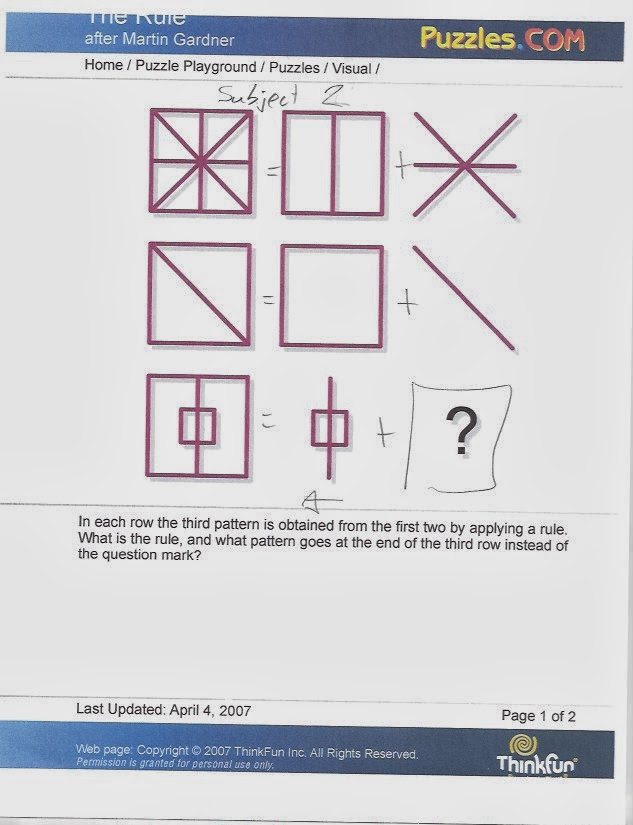
| Subject 2, The Rule |
Subject 1 followed a “pattern completion” methodology of trying to figure out the puzzle. Her line of site moved from left to right to solve the puzzle. Similar to what McKim states, she is ""filling in" [the] incomplete pattern and... "finding" a desired pattern embedded"" with the flow of the shapes moving her line of site from left to right. She visualized this pattern that was removed from Column 1 and deciphered it to figure out the end result of Column 3. Subject 2 also
followed a “pattern completion” methodology of trying to figure out the puzzle
but his line of site traveled from right to left, in a manner that was
more of an addition problem. His perception imagined what shape was needed to complete the shape for Column 1.
Monday, September 30, 2013
Week 6 Visual Perception 1, Top Down Visual Processing
The Instructions to build this Lego toy is an example of Top Down Visual Processing. The Goal-Directed Eye Movements guide the viewer, often times a child, to the goal of the building their toy. At each step of the instructions the viewer has short fixations in addition to Look-aheads to give them an idea of what parts they are going to need for the next stage of the instructions. Each stage of the instructions the viewer is determining which components they are going to need in addition to looking back at what they have currently completed as well. This maintains their attention on the instructions, while they repeat their top-down processes to their goal of completing the build of their car.
Monday, September 16, 2013
Interactions between 3 Three levels of Meaning; Representational, Abstract and Symbolic
![]() |
| Midori Araki's Stump Chair |
![]() |
| Midori Araki's Stump Chair |
Representational
The visual impact of the
Representational tree stumps for the end user is that of fun and humor. The
physical reality is a welcoming and engaging experience for those who want to
explore and see the tree stumps possible function. The Representational look is combined with
the other 2 levels by engaging the user to use the tree stump for the purpose
of sitting, while also symbolizing a sense of purity and innocence with it’s
white color.
Abstract
The role of abstraction within
the design of this tree stump chair could be from the designer’s experience of
being out in the wilderness and perhaps using a tree stump for the purpose of a
chair. The impact of this function-based abstraction comes out because of the universal end-user experience of using tree stumps as chairs or stools at
some point of their life. The abstraction of what is a tree stump relates to
the representational and symbolic because of man’s primal instinct of sitting
on tree stumps when out in nature.
Symbolic
The role of this design
is meant to recreate the relative simplicity of the chairs function. The chairs
look of the tree stump creates a conversational piece that engages the user to
wonder about the origins of this design. This modern approach could communicate
to the end-user how trees were a source of inspiration for being used to
fabricate chairs. It relates to the other two levels of meaning by creating a
sense of purity and simplicity with its use of color and shape.
Subscribe to:
Posts (Atom)


.jpg)


+motorcycle.jpg)